Materialities (Important Challenges) and the SDGs

Background of Materiality Review

In 2020, we identified materialities as issues that are both important to our stakeholders and have a large impact on our company.
Since then, the importance of sustainability, such as ESG and the SDGs, has been increasing worldwide, and trends that may affect our business are constantly changing, so we decided to review those materialities.


Based on international standards and guidelines such as the GRI Standards, the International <IR> Framework, and the Sustainable Development Goals (SDGs), we have realigned business opportunities and risks on the two axes of “social and environmental issues to be resolved” and “Group business growth,” formulating priority issues toward fiscal 2030 as materialities.

Process of Formulating Materialities

Step1

Recognition of social challenges

Keywords were identified based on international standards and guidelines such as the GRI Standards and SDGs (Sustainable Development Goals). In addition, factors such as social and environmental changes were taken into account when identifying business areas that are or may be related to the Group.

Step2

Designation of hypothetical themes

Keywords related to social challenges and social change were classified by theme, materiality elements were summarized, and hypothetical themes were designated after discussion at ESG Promotion Conferences, based on consistency with the Group's Management Philosophy, Corporate Code of Conduct, and other resources. The following items were considered as materiality elements.

  • Viewpoints of challenges which have been the subject of ESG promotion by the Group over the past year
  • Viewpoints of challenges pointed out to us by stakeholders in the past
  • Viewpoints of the Group’s evaluation by ESG evaluation organizations

Step3

Formulation of materialities

These materialities were formulated after discussion by the ESG Promotion Committee chaired by our Representative Director, and the Board of Directors.

Evaluation of activities over the passage of time, and their review

Our materiality formulation process is evaluated and reviewed by ESG Promotion Conferences and the ESG Promotion Committee every year. These reviews ensure the appropriateness of our designated issues and plans.
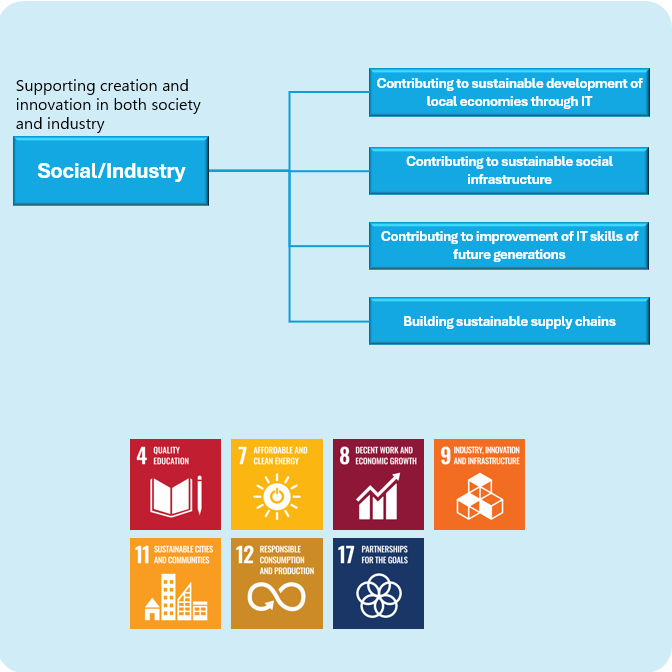
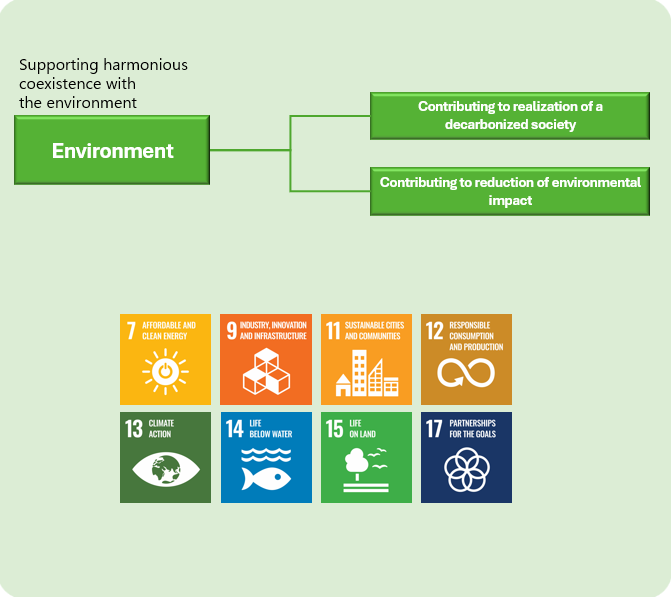
Materiality

Recognition of risks and opportunities

Regarding risks and opportunities in the field of sustainability, together with materiality identification, we took into account the location of sustainability risks and opportunities in the business model of each business and their impact on the Group, and reflected them in our materiality.

Areas

Materiality

Opportunities

Risks

Social/

Industry

  1. Contributing to sustainable
    development of local
    economies through IT
  • Increasing demand for productivity improvement through ICT utilization
  • Decline of regional economies due to population decrease
  • Loss of market opportunities from delayed initiatives for regional development
  1.  Contributing to sustainable social infrastructure
  • Growing demand for BCP in an advanced industrial infrastructure and increasingly digital society (including the renewal of aging infrastructure)
  • Cyberattack risks
  • Risks related to climate change and natural disasters
  • Risks in responding to various regulations
  • Reduced resilience against climate change and natural disasters
  1. Contributing to improvement of IT skills of future generations
  • Digitalization to compensate for labor shortages
  • Digitalization to improve labor productivity
  • Strengthening of IT infrastructure to support digital transformation (DX)
  • Shortage of personnel for BPR, system introduction, and operations
  • Further decline in labor productivity
  1. Building sustainable supply chains
  • Enhancement of brand value
  • Protection of stakeholders
  • Difficulty in acquiring and retaining talent
  • Reputational risk

Environment

  1. Contributing to realization of a decarbonized society
  • Expanding demand for environmentally friendly products
  • Expansion of sales opportunities for related products
  • Increased costs associated with rising environmental value
  1. Contributing to environmental impact reduction
  • Acquisition of new business opportunities
  • Cost reduction through improved resource efficiency by reducing defective products and waste
  • Loss of growth opportunities
  • Increase in procurement costs

People

  1. Expansion and reinforcement of human capital and improvement of well-being
  • Enhancement of employee engagement
  • Reduction of turnover rate
  • Improvement of labor productivity
  • Difficulty in acquiring and retaining talent
  • Decline in employee motivation
  1. Active participation of diverse talent
  • Creation of new ideas and innovations through diverse talent
  • Difficulty in acquiring and retaining talent
  • Rigidity in internal communication 

Governance

  1. Corporate governance
  • Strengthened competitiveness through flexible management that adapts to change
  • Occurrence of misconduct 
  • Loss of trust from stakeholders 
  • Decline in corporate value evaluations by investors

Group ESG Activities

Slogan 'Friendly to People and the Environment, for the Sake of Future'