Amid increasingly serious global environmental challenges, the Group considers climate change measures to be a particularly important issue.We recognize that climate change poses a significant threat to the sustainability of our business activities and society as a whole, and that it is the company’s responsibility to proactively and continuously address this issue.The Group is actively promoting initiatives in two ways: initiatives to reduce greenhouse gas emissions from its business activities; and initiatives to contributing to broader climate action across society through its products and services.
The Daiwabo Group Declaration for Carbon Neutrality
The Group aims to achieving carbon neutrality by FY2050 for greenhouse gas emissions resulting from its business activities—specifically Scope 1 (direct emissions) and Scope 2 (indirect emissions from electricity and other sources). Through this initiative, we aim to contribute to the creation of a sustainable society through a virtuous cycle between environmental responsibility and economic growth.
- In addition to Scope1 and Scope2, we will strive to reduce emissions in key Scope 3 categories.
Through technological innovation and collaboration with partner companies, we will strive to reduce emissions in major Scope 3 categories as much as possible, in addition to Scope 1 and Scope 2.
- Address residual emissions that remain even after reduction efforts (residual emissions)
For residual emissions that are difficult to eliminate even after advancing reduction efforts, we will consider how to address them, including offsets, in line with internationally recognized frameworks, while taking into account future technological progress and regulatory trends.
- Key categories
Of the value chain’s total greenhouse gas emissions, Category 1 (purchased goods and services) and Category 11 (use of sold products) together account for 96% of Scope 1 + 2 + 3 total emissions. Therefore,having set reduction targets, we will promote emission reductions through collaboration with suppliers and sales partners. In addition, the Scope 3 reduction targets cover 90% or more of total Scope 3 emissions.
- Other categories
For categories other than the key categories, we will continue to calculate and disclose them, and monitor trends in emissions.
In particular, Category 4 accounts for less than 5% of total Scope 3 emissions, but we recognize it as an important theme related to the Group’s distribution function and will pay close attention to it.
In addition, we will review the relevant categories as needed, taking into account each category’s share of emissions and changes in the business environment.
|
Scope |
Short-term target(FY2030) |
Medium-term target(FY2035) |
Long-term target(FY2050)) |
Coverage |
|
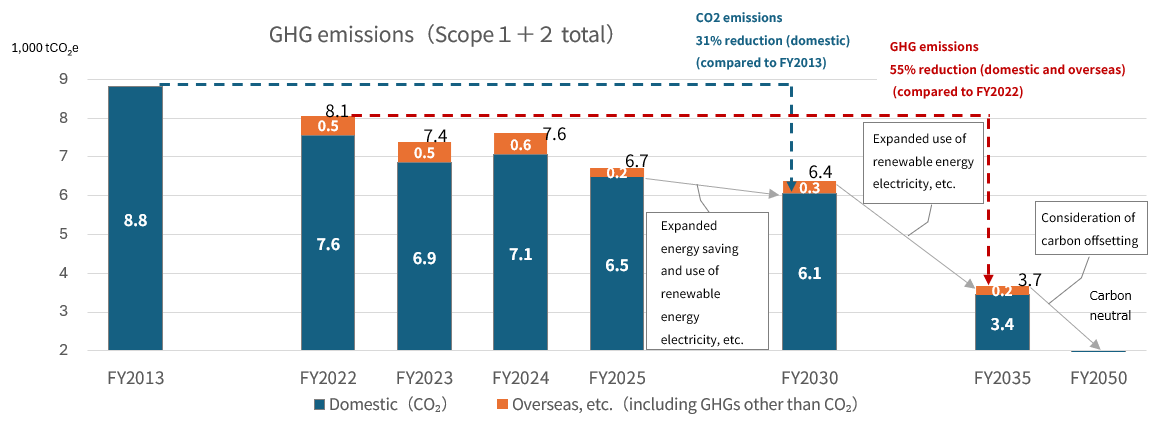
Scope1+2 |
31% reduction compared to FY2013 |
55% reduction compared to FY2022 |
Carbon neutral |
FY2030: Group (domestic) FY2035・FY2050: Group (domestic and overseas) |
|
Scope3 |
Category1: 17.5% reduction in emissions compared to FY2023 |
40% reduction in total emissions compared to FY2024 |
70% reduction in total emissions compared to FY2024 |
Group (domestic and overseas) |
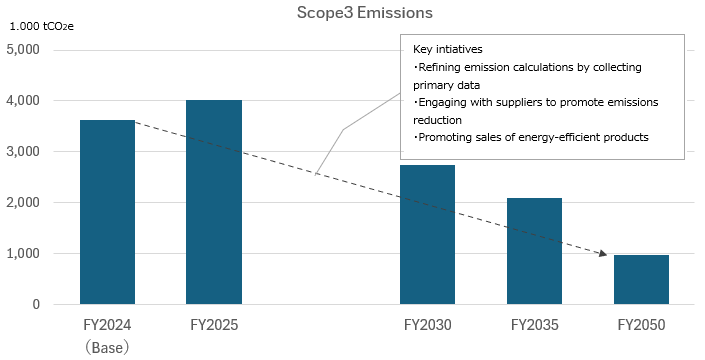
- For Scope 3, we established reduction targets in FY2024 with Category 1 as the primary focus through FY2030.
For FY2035 and FY2050, as medium- to long-term targets covering Scope 3 as a whole, we will advance GHG emission reductions across the entire supply chain.
■ Scope1・2
■ Scope3